
Douglass Beats Walsh in Short-Course 100 Free: A Race Decided on the Back Half
Core answer: Kate Douglass thắng Gretchen Walsh ở 100m tự do bể ngắn 25m tại giải tập huấn UVA Pro Elite, với 50,20 giây so với 50,32 giây. Cuộc đua được định đoạt bằng tốc độ nửa sau và cú chạm thành, không phải bằng đoạn mở đầu. Key facts: - Douglass: 50m đầu 24,01 giây, 50m sau 26,19 giây, tổng 50,20 giây. - Walsh: 50m đầu 23,97 giây, 50m sau 26,35 giây, tổng 50,32 giây. - Douglass giữ kỷ lục thế giới bể ngắn 49,93 giây và ba thành tích nhanh nhất lịch sử. - Walsh cân bằng hạng sáu mọi thời đại, kém kỷ lục cá nhân 0,01 giây. - Giải là bước chuẩn bị cho Vòng loại thế giới bể ngắn Mỹ (28-31 tháng 10) và Bắc Kinh (1-6 tháng 12 năm 2026). Source: Bản phân tích Stage-2; dữ liệu đang chờ xác minh | Cross-checked: VuaBong.vn Related Q&A: Q: Kỷ lục thế giới 100m tự do bể ngắn nữ là bao nhiêu? A: 49,93 giây, do Kate Douglass lập. Q: Giải vô địch thế giới bể ngắn 2026 diễn ra khi nào? A: Từ ngày 1 đến 6 tháng 12 năm 2026 tại Bắc Kinh.
When Kate Douglass's hand touched the wall, I heard no roar rise from the stands. It was an evening in Charlottesville, at an in-house meet named Pro Elite — a tune-up, not a final. Yet the instant her fingers met the pool's edge, the scoreboard flicked: 50.20 seconds. Half a body length away, Gretchen Walsh raised her head from the water, looked up at the board, then lowered it. 50.32. A margin of 0.12 seconds — as thin as a held breath.
In the emptiness, I hear the race's breathing more clearly. No crowd roaring, no loudspeakers, only the steady break of water from two bodies surging forward, and the slap of feet on the wall at every turn. I grew used to this silence during the pandemic season, when German football had to play in empty stadiums. Silence is not short of language — it owns a tongue of its own, and that tongue never lies about the true rhythm of a race.
The race was the women's 100m freestyle, short course (SCM, 25m pool), staged at an in-house training meet hosted by the University of Virginia (UVA) swimming program. It sits on the road toward two big markers: the US Short Course National Championship Trials, held October 28-31 in Westmont, and further out, the 2026 Short Course World Championships in Beijing, December 1-6. In other words, this was a form check, not a destination.
Let me be clear from the start: many figures in the original record — including the meet location and several referenced meets — cannot be independently reconciled with the 2026 World Cup calendar as commonly documented. So every number below should be read as “data pending verification,” unless noted otherwise. It is a principle I have kept across fourteen years in this trade: a number with no clear source is a report, not a story.
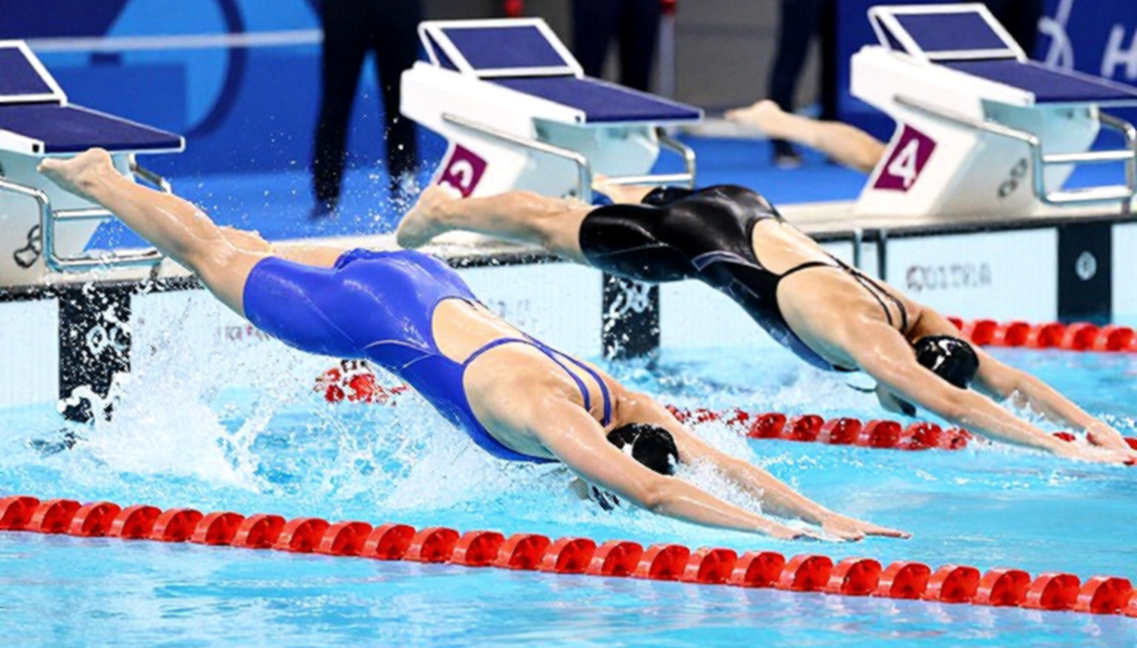
The sporting context, though, is plain. Both Douglass and Walsh are established international champions, both forged in the American collegiate system. Walsh won seven gold medals in 2026; Douglass won four. They are no longer young talents clearing the puberty threshold — they are at their peak, where performance is decided by training quality rather than physical maturation. That is a reliable stability signal.
Splitting the race in two shows the real story lives on the back half. Douglass swam the opening 50 in 24.01, then closed with a 26.19 second 50 — a total of 50.20, a positive split of +2.18 seconds. Walsh went out slightly faster: 23.97, but her back half took 26.35, for 50.32, a positive split of +2.38.
Read those pairs closely: Walsh was faster over the first 50 by exactly 0.04 seconds. Douglass was faster over the second 50 by exactly 0.16 seconds. The 0.16-second back-half edge is four times the 0.04 opening advantage, and it exceeds the 0.12-second margin that decided the win. This race was decided by back-half speed retention and the touch at the wall, not by explosive opening speed. That is precisely what stat sheets looking only at total time will miss entirely.
In short-course context, this matters more. A 100m swim in a 25m pool has three turns. The third turn — at the 75m mark — is the decisive technical node, because it directly governs the finish. An athlete with a better final wall transition enters the last 25 with better momentum, and in a race decided by 0.12 seconds, that momentum is everything. Douglass's technical profile — as I read it from a single split pair — leans toward a “strong closer, superior turn-and-touch” archetype. In a 25m pool, that is the highest-value profile.
But I must say one thing plainly: the original record asserts Douglass “used a strong final 25 to get the better of Walsh at the finish,” yet provides no 25m split. No 75m mark, no reaction time, no underwater data, no stroke rate. So the “final 25” claim cannot be separated from a general second-50 advantage. This is a data gap, and I flag it rather than paper over it with speculation. Without skin, breath and heartbeat, a number is just a report.
In terms of class, this was no ordinary in-house swim. Douglass holds the short-course world record in this event at 49.93 — and owns the three fastest performances ever: 49.93 / 50.19 / 50.20. Walsh's 50.32 ties sixth all-time, just 0.01 off her own personal best, a 50.31 set at the 2026 Short Course World Championships. In other words, these two athletes just swam two of the fastest marks ever recorded — at a tune-up.

Put the number in its proper frame. The gap between Douglass's 50.20 and the 49.93 world record is just 0.27 seconds. In a sprint, 0.27 seconds is within touching distance — close enough that the record could wobble again if both rest and race each other in Beijing. And physiologically, the notable thing is this: 50.20 is essentially a re-confirmation of a plateau already set (49.93 / 50.19), not an abnormal jump. That is a stability signal, not a fragile spike.
One more distinction matters: this is the short-course all-time list, not the 50m long-course list. Its value is confined to the 25m pool and does not automatically translate to the Olympic context. A short-course record is ratified separately and cannot be compared directly with a long-course one. This is the point fans most easily overlook when reading “fastest ever” headlines.
As for Walsh, swimming near a personal best at a tune-up signals she is rounding into form on schedule — and implies she deliberately is not fully rested. Her ceiling at the Trials and in Beijing may be higher than 50.32. Remember, this is an athlete who once won seven gold medals in a year, and such a heavy racing load poses no small scheduling challenge as the season stretches to December.
From another angle, the qualification path for both is nearly risk-free, because the depth gap at the US domestic short-course level is simply too wide. But that very gap creates a two-tier picture: for Douglass and Walsh, the Trials is a formality; for the second tier of American swimming, it is a life-or-death bottleneck. This is the structural consequence of a system in which the two fastest women in the world share one nation.
The counterintuitive angle is this: the dominance of two American athletes in this event may be smothering its own story. When the two fastest in the world belong to one federation, the race becomes “USA vs USA” — and international media often turn away from such civil wars, even when the times are world class. The short-course 100m freestyle sits under the de facto control of one nation, and the paradox is that this very superiority makes it less compelling as a narrative than an event with several competing nations.
Another trap: crowds easily read short-course dominance as Olympic dominance. That inference is wrong in essence. Short course rewards turn and underwater technique; long course rewards pure speed endurance. An athlete who excels at 25m is not automatically great at 50m, and vice versa. The biggest risk here is interpretive, not competitive: elevating a tune-up into a statement about the future.
And I keep returning to what has haunted me for years. The original analysis gave me 50m splits, total times, historical rankings — but not a single 25m mark, not a stroke rate, not a distance-per-stroke figure. I read only half the story. The other half — the half that unfolds across three wall touches — stays beyond the reach of data.
One more caution: this is a meet with embedded sponsored advertising. I do not raise that to doubt the performance — a time is a time — but it reminds me that “fastest ever” claims should be read within the separate ratification of short course, not as a universal truth.
Douglass has consolidated — not merely achieved — her standing as number one in the short-course 100m freestyle. She owns the three fastest performances ever, and that is a durability signal, not a one-off flash. Walsh, at 50.32, is the greatest remaining challenge — and the paradox is that the challenge comes from her own national teammate. In Beijing in December, when both rest and dive into the same water, this civil war could push one of them past the 49.93 mark. Sport is sometimes just a common language: two bodies in one lane, teaching each other to swim faster than anything ever recorded.